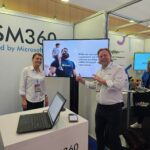
Following our introduction of ITSM360 in the Netherlands, we have received many positive and interesting responses. It is striking that some people think we see the installation of ITSM360 for companies as the goal, but that is not the goal at all.
ITSM360 is the means to jointly organize a much higher goal: happy users who participate in order to jointly achieve the highest possible return from ICT services.
We have had a fixed approach to this for 20 years, which now also integrates perfectly with ITSM360, enabling us to guarantee user ratings of 9+ at lower costs. This completes the circle, and we would be happy to explain this to you.

Making services measurable based on the service catalog
To begin with, you will need to connect with the users who value your IT services. This requires setting up services 'as a service', i.e., services that users recognize, such as a workplace, a meeting room, etc. With ITSM360, this can be measured as standard using Power BI: for all services, but of course also separately per service, per ticket, etc. And to really bring this to life within the management department, we like to project it in real time on a central screen.
Organizing ownership of services and service provision: what is the difference?
If services that are recognizable have also become measurable, it is possible to assign services and service provision to owners. But what is the difference between services and service provision? To explain this, we like to use the comparison with a car: the car as a whole is the service, but for maintenance, the car must occasionally go to a garage, and we call this service provision. You can also organize this perfectly well with ICT services. The workplace as a service can, for example, be assigned an owner, but the processes as service delivery can also be assigned owners. We often see services being assigned two owners: one within the management department and one from the user organization. For service delivery, ownership usually falls within the management department.
Organize objectives for owners and establish how to evaluate them
Ownership is only enjoyable if there are sufficient tools and bodies in place to convert ownership into better results. That is why we always ensure that owners are given achievable goals and the resources to take control of improvements. But it will also be necessary to agree on the reward if, for example, the goals are achieved. Otherwise, motivation will be short-lived. It is also very enjoyable to discuss together what would be an appropriate reward, such as educational training or perhaps even a higher salary.
Start with a baseline measurement and ask your users to help out.
Improvements require a baseline measurement beforehand, otherwise there is little to compare. You will also need help from your user organization to improve together. Fortunately, IT is no longer just an administrator's party. For the baseline measurement, it is wise to conduct an audit, often with external guidance, in which you ask employees both inside and outside the administration department what they think of the existing services and the existing service provision. And you can guess: this only makes sense if the employees involved recognize this. Asking people what they think about the availability of your server does not make much sense. We often ask employees directly and personally what could be improved and how. This opens the door to working together to improve and innovate.
In addition to a CAB, also organize an Innovation body.
Daily reports and requests, for example, are handled reactively. These are discussed by a CAB (Change Body) if multiple roles are involved. However, in order to truly improve services and service provision in a structural manner, there must also be a proactive body to convert measured results into structural improvements. To this end, we are setting up an Innovation Body with a proactive character, which often includes people from the user organization to discuss the given assessments and work together on improvements.
Because ITSM360 continuously measures ratings with Power BI, it will quickly become clear whether the desired result is actually realistic.

Start small; most plans fail because they are too ambitious.
Often, the most attractive and effective plans are developed by expensive consulting firms, and then it is expected that these plans (often referred to as "digital innovation") will be rolled out and implemented across the entire organization. We believe this is a significant error: these changes require many different roles, considerable adjustment, appropriate governance, and, above all, an approach and evidence for each measurable service.
We understand better than anyone the enormous effort required to improve services and service provision, which is why we always start small: by demonstrating an improvement in, for example, one service and one process. Only when the improvements prove to be realistic in practice and measurable using the ticket system do we schedule the next improvement. In almost all cases, lessons learned are also applicable here, and the focus is on assurance and control within your management department.
It's actually quite simple: if his approach and results are not satisfactory in one department, then (without proof) this will apply to all departments and, in our view, the process will have failed.
Standardize success and make it easy to repeat success
Measurable success always has certain characteristics. We have a proven model for this. These characteristics can then be standardized. Think of certain process steps that are successfully completed by designated roles. If this proves to be the case for one particular service, then it is of course possible to use it repeatedly for other services. The same applies to bodies such as a CAB or innovation body. The focus then shifts to simplicity: repeating successes achieved for other services. First prove it on a small scale, learn from it, standardize it, and finally repeat it on a large scale.
Make the ITSM system the hub between supply and demand
The ITSM system should really be the primary system between supply and demand of services and service provision. Logical, you might say, but with over 20 years of experience, the ITSM system has always proved to be the weakest link.
People are quick to assume that we use ITSM360 as if we were a software supplier, but nothing could be further from the truth. The only reason we use ITSM360 is because this system can finally deliver all the added value needed to successfully connect supply and demand.
To this day, all reputable systems have been designed based on the perception of accountability as an administrator or management party. And usually based on management components rather than services that users recognize. Measurable user experiences (XLA/UX) are impossible to organize or unaffordable for the average organization. This really had to stop, because the success of our clients is also our success, and this was largely determined by a flawed ITSM system that did not connect with the user organization.
Based on the current trend, whereby more and more services are being purchased 'as a service', we dare to say that the architecture of the well-known ITSM systems has reached the end of its life and no longer meets the requirements of modern management.
Integrate, connect, automate: it's high time
What should your ITSM system be able to do, besides acting as the hub between supply and demand with Microsoft Teams? To start with, the system must be easy to integrate with everything. And what are we talking about here? All possible Microsoft licenses and products that virtually all organizations already purchase within their existing license structure. Microsoft Teams for communication with users, but also between administrators, other departments such as HR and facilities, and external management parties, for example.
But that's just the beginning: people also want to integrate with, for example, AD, Intune, SCCM, Endpoint Manager, Power BI, and Power Automate. The common denominator of these solutions is that they are all Microsoft solutions. So how do you integrate them with an ITSM system that is not Microsoft? Unfortunately, the answer is a familiar one: not at all, or only with very expensive extra modules or customization. And so there is insufficient integration.
Connecting to APIs, for example, is also difficult or impossible. This quickly leads to the conclusion that without integration and connection, you cannot automate tasks and processes from your ITSM system. And that is precisely what every end user is now asking for: finally automate automation, so that we can be helped faster and better through self-service. This keeps you stuck in an unpleasant vicious circle, with the end result being very expensive systems, lots of administrator screens, and no happy users at all.
I would like to come back to ITSM360: it can facilitate all these things 'out of the box' as standard. And because ITSM360 is 100% Microsoft, it can also be much more cost-effective with a much better end result: demonstrably happy users. This will truly become the new standard.
Start a Proof of Concept or, more modern: a Proof of Value
Many organizations cannot yet imagine that everything can be done much better, simpler, and more cost-effectively by working with an ITSM system that meets all modern requirements and wishes and uses MS Teams as its medium. That is why we always propose a Proof of Concept, but even that is actually an outdated term, as the concept has long been proven. We believe Proof of Value is a more appropriate term.
During such a process, we install ITSM360 within your existing ecosystem and alongside your live environment within a maximum of one working day.
But because it is part of your ecosystem, we work with you to integrate, connect, and automate everything into a single service. We measure the value of this service and service provision, involve administrators and users, and simply prove that it is many times better.
If you like what you see, we will continue to build the environment together at your pace, and only when we are both truly ready will it be time to shut down the old ITSM system. That is what modern means: an enjoyable and effective process, without half measures or a huge "big bang."
And finally: take good care of your people and provide coaching.
We almost always find that your administrators or service desk employees have difficulty keeping up with the changes. We also often see that, due to the shift to cloud solutions, these people are considered 'redundant'. We believe this is a huge mistake: these people have a wealth of knowledge about your organization and can make a valuable contribution to improving your services in a different role. It is precisely these people who can work with modern systems, automate processes and tasks themselves, learn to take control of all dependent links and parties, etc., etc.
We have been around for a while and know that if you don't include these people in this change, we will slowly return to the era of outsourcing (around 2000), when services were outsourced in their entirety to external parties. In all cases, this resulted in much lower end-user satisfaction and much higher costs: we believe that this development should never be repeated.
If, for example, you are going to work with a Microsoft Unless strategy and ITSM360, your existing employees can easily become the owners of systems, services, and processes themselves. This only requires the right guidance and coaching, which we are happy to offer you.
Author: Dennis Daalhuizen