Providers like to make things sound better than they are.
Every day, we talk to organizations that have just replaced their ITSM/ESM solution, but have been disappointed in terms of costs, promises, and possibilities. After all, the websites listed a very attractive and comprehensive price to meet all our requirements and wishes: if only we had paid closer attention, drawn up a complete list of requirements, and made a good business case for five years.
The end result: organizations end up paying no less than three times more than initially budgeted. A terrible waste and, above all, unnecessary.
Base your PvE on what you want to achieve in 5 years, not on what you already have!
The biggest pitfall when replacing ITSM/ESM solutions is that the Requirements Program is often based on what we already have and use.
And so not: what we all want to achieve in the coming years and therefore do not yet have, or already know ourselves.
It is normal to involve various internal stakeholders in order to arrive at the right requirements and wishes. And that is where things go wrong: internal staff do not have a clear picture of what is available on the market. That is quite logical. That is why it is wise to organize inspiration sessions with a number of external parties before the PvE is finalized: parties who can show you what is possible.
If you want to manage your workplaces automatically via AI in the coming years, this must be taken into account now, in the request for quotation. It turns out that it is precisely all these 'unknown requirements and wishes' that lead to unpleasant surprises: "Oh, AI, well, that's an extra module!" And: an extra project, an extra subcontractor to manage... and so on. And the worst thing is: most providers hide those costs in advance, because: inside is inside, right?
After that, no one will replace this solution within 1-5 years, if only to avoid losing face, due to the negative surprises.
Our advice and our passion: prevent this from happening together, which is possible with a good PvE, logically followed by a sound substantive and financial business case.
Create the right business case for 5 years:
Once you know what is possible, you need to determine whether and when you want to implement such requirements and wishes in the next 3-5 years. We always recommend investing time in this, and we are happy to help. If you decide to do this yourself, our advice is to invite previous parties to complete this business case with and for you, for example during an RFI/RFP phase (information and quotation phase). Simply require that each provider submit a comprehensive budget in advance: based on 5 years, but also based on all the requirements and wishes mentioned. This will guarantee that you avoid unpleasant surprises afterwards and also prevent you from choosing the wrong party: which is nice!
If the strategy is "Microsoft, unless," then find the right solution for that.
Almost all organizations already use a huge number of Microsoft Point Solutions. An absurd amount, in fact. Our advice and motto in this regard is: choose an ITSM/ESM solution that fits in with this.
Below is an example of what can happen if you don't take this into account, but also what you can achieve if you do: a real-life case study, before and after the decision:
The situation beforehand:
1. Excessive costs of the existing ITSM platform
Licenses, modules, and links continued to pile up. API modules in particular were expensive to purchase and maintain.
2. Low adoption by employees
Employees had to log in again, visit different portals, learn new screens, and navigate through complex, unnecessary fields and environments. This slowed down registrations, increased ticket volumes, and... greatly reduced user satisfaction!
3. Dependence on external consultants
Integrations were complex, expensive, and time-consuming. The Microsoft 365 environment was never fully utilized.
The previous ITSM solution had multiple cost layers:
- High implementation and training costs due to the complexity of the platform.
- Additional paid modules and API connections for missing functionality.
- Annual license fees that increased with expansion.
- Maintenance costs for modules and integrations.
This resulted in a high total cost of ownership (TCO) and limited flexibility.
The situation afterwards (based on ITSM360, 100% Microsoft):
The client was looking for a solution that:
- Runs entirely within Microsoft 365
- No external modules or connectors required
- Uses Teams, Power Automate, SharePoint, Power BI, and Co-Pilot
- IT, Facility, and HR provide internal support from a single platform
- Customer support/ticket portal facilitates our own clients
- Integrates with the five most essential business applications
- AI deployment for knowledge sharing, but in the future also for automatic management
- Structurally reducing the TCO
ITSM360 meets all these requirements. By running entirely within Microsoft 365, there are no costs for additional integrations, separate databases, or supplementary technical modules. In addition, hardly any training is required because employees can continue to work with tools they already know. After all, they already work with MS Teams, and ITSM360 works within it as standard. The advantages of Microsoft native ITSM.
The business case in brief
The table below shows the most important cost items.
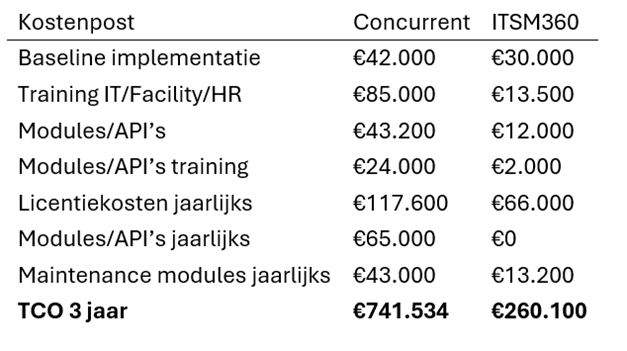
The biggest differences include:
- The complete elimination of module and API costs, an expense that amounted to more than €65,000 per year with the previous solution and is now completely zero with ITSM360.
- Significantly lower training costs thanks to in-house Microsoft expertise: a reduction from €85,000 to €13,500, or more than six times cheaper.
- Lower licensing costs due to its Microsoft-native nature: almost twice as cheap in comparison.
- Less maintenance thanks to standard Microsoft integrations: maintenance costs fell from €43,000 to €13,200, more than three times cheaper.
In total, the TCO over three years was almost three times lower than in the previous situation.
Savings beyond software costs
The client benefited not only from lower ownership costs, but also from broader operational advantages. Automation in Power Automate and Power BI simplified maintenance and reduced the number of manual tasks. Processes could be adapted more quickly because everything runs on Microsoft standards. In addition, better insight into users and assets led to the cleanup of inactive Microsoft licenses, resulting in additional structural savings.
Additional benefits and results
The switch to ITSM360 not only resulted in significant cost reductions, but also provided:
- Simpler adoption thanks to Service Management in Teams, which meant employees did not have to learn a new system.
- More stable compliance because all data remains in your own M365 tenant.
- Less dependence on external suppliers.
- More room for innovation within the IT department.
- Users and practitioners work with the AI Happy Helper, based on Co-pilot.
- One solution for reports from clients and internal departments
Conclusion
The case study shows that organizations that rely heavily on Microsoft 365 can reap significant benefits from an ITSM/ESM platform that runs entirely within this environment. ITSM360 substantially reduced costs, simplified management, and improved the user experience.
Large, regulated organizations in the Netherlands and Europe that want to renew their ITSM package can no longer ignore ITSM360. By fully utilizing existing Microsoft licenses with a Microsoft-native ITSM platform, the TCO is at least three times lower than with traditional ITSM/ESM solutions.
This positions ITSM360 as a distinctly disruptive alternative to the established order.
Want to know more? Request a demo and discover why more and more organizations in over 30 countries are choosing ITSM360.